Exploring Venus: What’s the Deal with Earth’s Sibling Planet?
Ever stare up at the night sky and catch that unusually bright star? Wondering what its deal is? Chances are, you’re exploring Venus without even knowing it. This cosmic neighbor, a real looker, has just blown people’s minds for ages. And its almost otherworldly glow, super noticeable even in broad daylight sometimes, has given it this spooky, enduring vibe.
Why Venus Blazes So Damn Bright
So, why does Venus hog all the celestial glory? Simple math, really. It’s a huge planet, practically Earth’s twin. And it’s practically right next door. That means the light reflecting off it doesn’t have far to travel to hit our eyeballs.
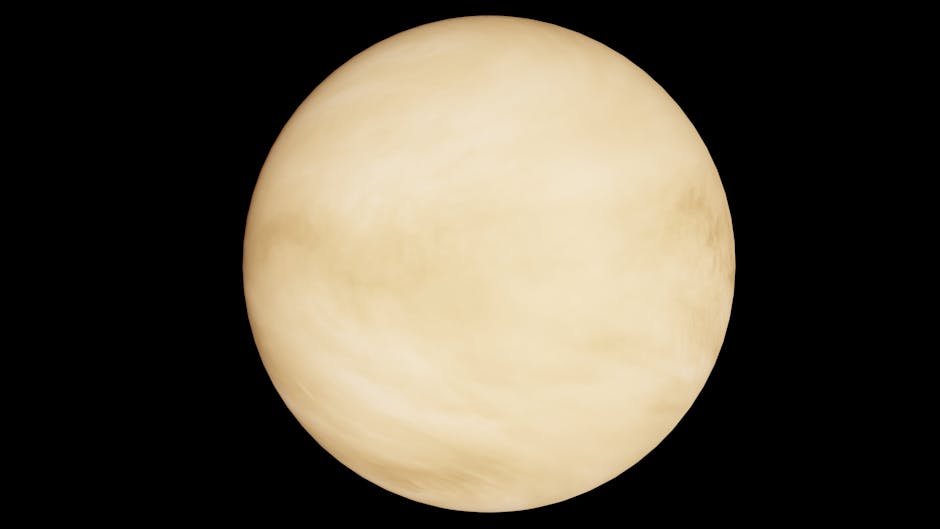
But here’s the kicker: Venus is wrapped in dense, white clouds. This isn’t some thin haze; it’s a reflective blanket. It bounces sunlight back into space super efficiently. Makes Venus appear way brighter than any other object in the night sky, besides our Moon.
If you looked through a telescope, you wouldn’t see a landscape with lots of variety. You’d see a gleaming, white billiard ball. This bright cover totally hides a fiery, brutal reality underneath. Pretty deceptive, huh?
Historically, People Thought it Was “Livable”
Before we knew its true brutal nature, Venus was a place we just plastered our wildest dreams onto. Ancient observers even thought the morning and evening appearances were actually two separate celestial bodies. They gave the morning star names like Phosphoros or Lucifer, and the evening star Hesperus. Two different things!
But then, with its size so close to Earth’s, and only about 75% of our distance from the sun, early thinkers figured it might even be more habitable. Just imagine: French writer Bernard de Fontenelle, in 1686, pictured Venus as a spot where sun-tanned inhabitants lived passionate lives. Filled with music and parties and love. Talk about a chill spot!
This romantic idea, even translated into English by that pioneering writer Aphra Behn, painted a picture of a warmer, more vibrant world. It was just what humanity longed for. A truly wild historical vibe.
Galileo, Secret Codes, and Cosmic Truths
Even with crappy telescopes, Galileo turned his focus to Venus and found something totally revolutionary. He could only glimpse that bright cloud cover, kind of like those old-school telescopes in Florence museums nowadays. But what he did see? That was a game-changer.
Galileo carefully watched Venus going through phases, just like our moon. This wasn’t some minor observation; it directly implied that Venus orbited the Sun, not us. Because it challenged ancient dogma and church teaching. For millennia.
Knowing the risks — he’d eventually face house arrest for similar “heresy” — Galileo sent coded messages to his friend Johannes Kepler. He used a Latin anagram hinting that “things still unripe for utterance have been observed by me.” Rearranged, it revealed that “the mother of Loves (Venus) imitates the phases of Cynthia (the Moon).” This secret message confirmed Copernicus’s heliocentric model, establishing a new understanding of our solar system. Sometimes, the biggest truths start as whispers in code.
Soviet Pioneers: First Look at a Hellish World
The crazy old ideas of Venus were shattered by science probes. The Mariner 2 flyby in 1962 confirmed surface temperatures exceeding 400 degrees Celsius (750 degrees Fahrenheit). The U.S. focused on the moon, but the Soviets, led by engineer Sergey Korolyov, poured their efforts into Venus and Mars with the Venera program. And another thing: these guys were relentless!
In 1970, Venera 7 became the first craft to land on another planet, sending signals for 20 minutes before it gave up in the intense environment. Venera 8 fared better, but still only lasted an hour. But the real breakthroughs came with Venera 9 through 12. These missions carried cameras. And though many failed on entry, some managed to capture the first-ever images from the surface of Venus.
We’re talking actual, direct photographs from another alien world. Later, NASA joined the action with Magellan in the late 1980s. Mapping Venus’s surface in insane detail.
A Runaway Greenhouse: Earth’s Warning Label
Underneath that beautiful, reflective cover is a truly hostile planet. Venus’s surface is just volcanic rock and solidified lava flows. Its atmosphere is crazy dense, mostly carbon dioxide, nitrogen, and sulfuric acid. Imagine the pressure: it’s like being a kilometer deep in Earth’s ocean. Yeah, that’s heavy.
Acid rain happens all the time. Bad news for any spacecraft sent there. Pioneering scientist Carl Sagan warned way back in 1961 that a runaway greenhouse effect had cranked Venus’s temperatures to nearly 500 degrees Celsius (932 degrees Fahrenheit). So hot.
This blistering place shows us what an unchecked greenhouse effect can do. Venus is a chilling reminder that our own comfortable, delicately balanced Earth isn’t safe from such drastic climate changes.
Venus’s Violent Volcanic Past
Magellan’s mapping showed that Venus’s surface is relatively young, geologically speaking. Most of what we see formed about 500 million years ago. This suggests a colossal volcanic event just swallowed the entire planet, completely resurfacing it with magma and volcanic rock.
The planet, quite literally, reshaped itself from inside. This enormous planet-changing event wiped away most traces of its earlier history. Making Venus’s early conditions a tough puzzle to crack.
The Lost Oceans of Early Venus
When planets first formed roughly 4.6 billion years ago, Venus and Earth probably started out pretty similar. Just like newborn babies sharing similar traits before individual genetics kick in, early Venus might have been a lot more livable.
Scientists believe Venus once had liquid water, maybe even oceans. But beyond just volcanic activity, that dramatic greenhouse effect likely went into overdrive. This hellish heat would have boiled away those ancient oceans. Eventually, it just changed that once potentially watery world into the scorched, acidic, and hellish landscape we see today.
Our journey through the solar system is just beginning. As we leave Venus behind and head for our own blue marble, remember this: we’ve got one precious home. Let’s learn from our cosmic neighbors.
Frequently Asked Questions
What makes Venus so bright in the sky?
Venus is bright because of its large size, how close it is to Earth. Also, a dense, white cloud cover that reflects sunlight super efficiently back into space.
Did people always know Venus was just one planet?
Nope. For a long time, ancient observers confused Venus appearing as the morning star (Phosphoros/Lucifer) and later the evening star (Hesperus). They thought they were two totally different things!
What was the first spacecraft to land on Venus?
The Soviet Venera 7 mission successfully landed on Venus in 1970. Becoming the first spacecraft to land on another planet. It sent back signals, even if only for 20 minutes.